Compare
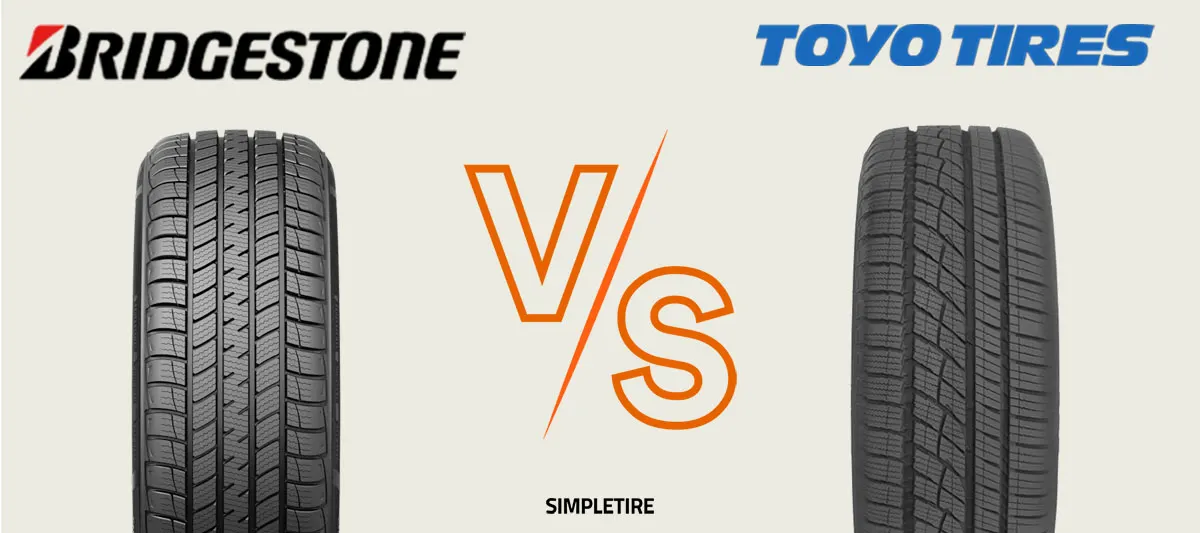
Bridgestone UltraWeather vs Toyo Celsius II tires
Free shipping
Best price guarantee
SimpleCrew exclusive savings
0% APR Financing
Tire replacement coverage
24/7 roadside assistance
Easy returns
Compare
Bridgestone is one of the world’s largest tire manufacturers that has a deep-rooted motorsport legacy, which makes sharp handling, cornering, braking, and faster acceleration the core aspects of any Bridgestone tire. The Japanese tire manufacturer was established in 1931 and has several manufacturing plants across the globe in different countries.
On the other side, we have another Samurai from Japan that’s been around for more than 80 years. Toyo rolls out high-quality tires that offer robust durability, longer service life, and excellent on- and off-road performance. It manufactures passenger cars, SUVs, CUVs, minivans, EVs, and ATV/UTVs.
Both brands have a presence in all-season, all-weather, all-terrain, winter, UHP all-season, and highway-terrain categories. Drivers often pick all-weather tires as a reliable option to combat unpredictable weather conditions, as these types of tires can perform from dry and rainy to freezing conditions.
The Bridgestone UltraWeather and Toyo Celsius II are great all-weather tires that are designed for passenger cars, CUVs, minivans, and SUVs. Both are backed by Three Peak Mountain Snowflake certifications, which means they can be used in frigid areas where the temperature drops below 45 degrees Fahrenheit. The UltraWeather and Celsius II are also covered by solid mileage warranties for complete peace of mind.
So, which one makes more sense? Let’s decode and compare the two tires in this Bridgestone UltraWeather vs. Toyo Celsius II tires comparison using our SimpleScore. It’s our in-house scoring mechanism that rates each tire on a scale of 0 to 10 for traction, handling, and longevity. Without further ado, let’s hop in to find out which is the better deal.
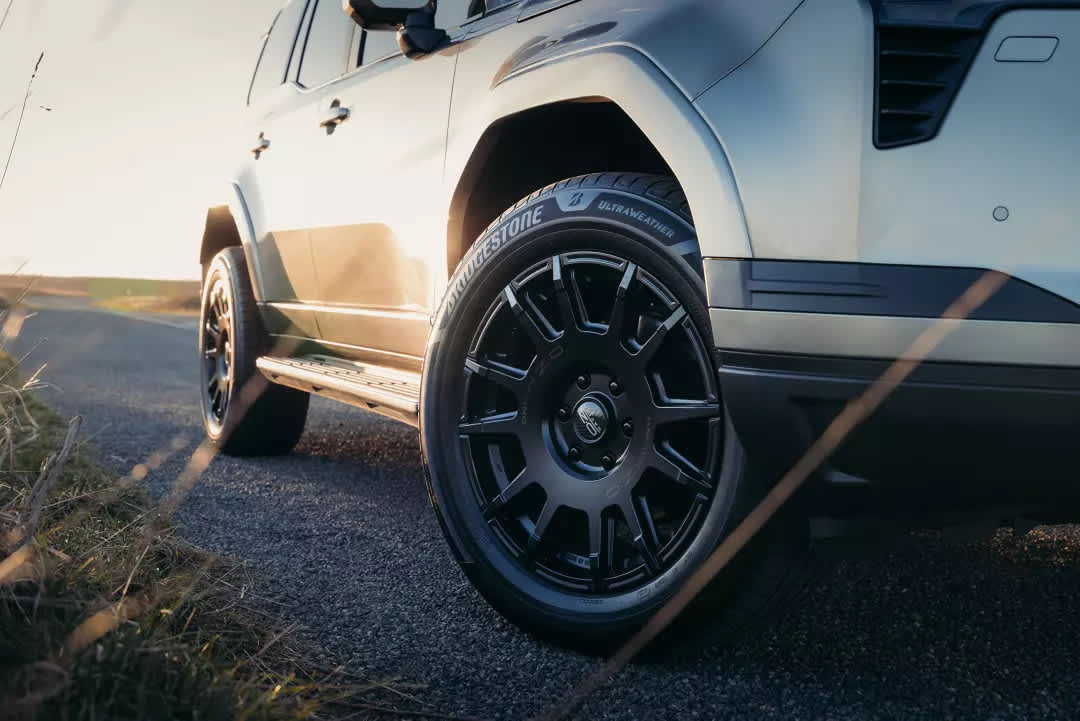
Introduced in 2026, the Bridgestone UltraWeather is an incredible all-weather tire if you want exceptional traction, braking, handling, grip, and longer service life. Designed for passenger cars, CUVs, and SUVs, the UltraWeather delivers excellent stopping distance and reassuring stability and grip on dry, wet, and snow-packed surfaces, all credit to its ENLITEN technology and advanced rubber compound. Covered by a 60,000 mile limited manufacturer tread life warranty, the Bridgestone tire provides low rolling resistance for increased fuel efficiency.
Scoring 9.0 in its overall SimpleScore, the Bridgestone UltraWeather returns superior traction, handling, and tread life.
Get Bridgestone UltraWeather tires at the best deals for your vehicle here
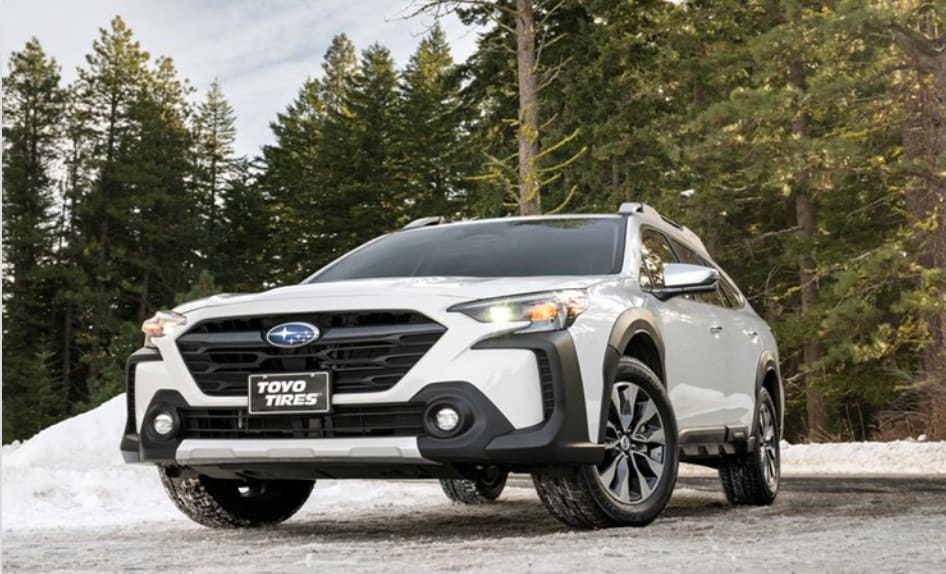
Designed for CUVs, SUVs, and passenger cars, the Toyo Celsius II was introduced in 2023 and provides a solid mix of great tread life, grip, traction, and steering response. Packed with an advanced rubber compound and snow claws, the Celsius II provides solid grip, traction, and control on snow and, at the same time, improves wearability. With the Three Peak Mountain Snowflake certification, the Toyo tire returns reliable control and traction in deep snow and ice. Backed by a 60,000 mile limited manufacturer tread life warranty, the Toyo tire assures impeccable longevity in unpredictable driving conditions.
With an 8.9 overall SimpleScore, the Toyo Celsius II promises lasting tread life with great traction and handling.
Get Toyo Celsius II tires at the best deals for your vehicle here
Whether it’s dry, wet, or snowy, strong grip ensures you are safe and in control of your vehicle. This makes traction significant. Both tires are exceptional in this regard, but one of the tires displays superior braking and traction skills.
With an excellent traction score of 9.2, the Bridgestone UltraWeather offers superior grip that also ensures exceptional braking and traction in unpredictable weather conditions. The unique tread pattern with hundreds of wavy sipes provides extra grip and traction on wet and slick surfaces. Additionally, circumferential and lateral grooves push water and slush out of the footprint to avoid the risk of hydroplaning and deliver consistent traction and grip on snowy and rain-soaked surfaces.
On the other hand, the Toyo Celsius II scores an 8.8 in traction, making it a dependable tire for unpredictable conditions. While the optimized tread design features sipes and zigzag tread blocks that provide extra biting edges for reassuring grip and traction in slick conditions, the silica-infused rubber compound improves flexibility and boosts traction in wet and snowy conditions. It features snow claws that dig into deep snow and packed ice to deliver reassuring grip in slush and snow.
With a higher score, the Bridgestone UltraWeather wins the opening round.
ADVANTAGE: Bridgestone UltraWeather
Slick regions demand tires that offer effective grip with strong ground-holding abilities. Quick maneuvers on such surfaces are only possible when your tire ‘listens’ to your steering inputs precisely. Let’s see who wins the critically important handling battle.
Continuing its outstanding run, the Bridgestone UltraWeather ranks an incredible 9.1 in handling, which means precise steering feedback, improved highway stability, and confident high-speed cornering in wet and snow. Thanks to its solid shoulder design and symmetric tread pattern, the UltraWeather delivers quick lane-changing ability and excellent control on paved roads.
Contrarily, the Toyo Celsius II is at home with an 8.8 handling score. Thanks to the interlocking multi-wave sipes on the shoulders, the Toyo tire provides reliable grip and control on rain-soaked and snow-covered roads. The unique rubber compound of the all-weather tire ensures the tire sticks to the surface even at high speeds and does not skid.
It’s the Bridgestone UltraWeather yet again. It now leads the comparison by a 2-0!
ADVANTAGE: Bridgestone UltraWeather
All-weather tires are preferred for their longer service life. The UltraWeather and Celsius II offer excellent tread life, but one of the two surprises with its extraordinary performance. The Bridgestone UltraWeather boasts a superb 8.9 in tread life, meaning it can last up to a great number of miles. The 60,000 mile limited manufacturer tread life warranty further reinforces that it’s a mile muncher. The use of Bridgestone’s ENLITEN technology not only ensures controlled wear but also resists premature wear. Lastly, the PeakLife polymer of the Japanese tire maker ensures flexibility in frigid conditions that aids in providing longer service life.
With an incredible 9.1 in longevity, the Toyo Celsius II ensures superior tread life and strong durability in unpredictable weather conditions. While the asymmetric tread pattern enables cross rotation to reduce chances of irregular wear, the durable sidewall balances load and driving pressure for a longer service life. Backed by a 60,000 mile limited manufacturer tread life warranty, the Celsius II features an inner casing and advanced rubber compound to optimize wear rate.
Bouncing back, the Toyo Celsius II turns up the heat on the Bridgestone UltraWeather to win the longevity tussle.
ADVANTAGE: Toyo Celsius II
All-weather tires are designed to offer year-round performance in unpredictable conditions, including moderate to severe snow. For drivers wanting an all-weather tire with incredible grip, braking, traction, and handling, the Bridgestone UltraWeather is an excellent choice. However, for those who want longer service life with adequate traction and handling, the Toyo Celsius II is the right option.
Both tires can be used in severe winter conditions of deep ice and snow, as they are Three Peak Mountain Snowflake certified. In terms of sizes, the Bridgestone UltraWeather is offered in 16 to 22 inches, while the Toyo Celsius II is available in 15 to 22 inch sizes.
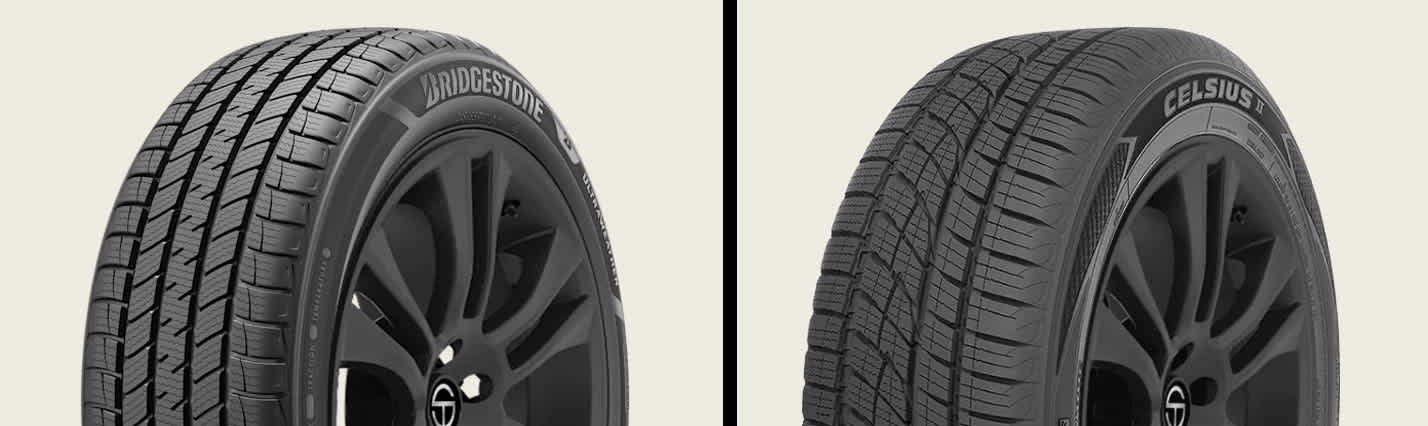
To sum it up, the Bridgestone UltraWeather is an overall better tire than the Toyo Celsius II (9.0 vs 8.9). However, each tire has its own unique characteristics which should be considered and matched with your driving needs and budget.
That said, let’s compare the prices of the 205/50R17 93V XL tire size. Each Bridgestone UltraWeather costs around $220, so four tires total $880. On the other hand, one Toyo Celsius II costs around $166, which means four such tires would cost you approximately $664.
Based on SimpleScore, you should buy the Bridgestone UltraWeather if you:
On the other hand, you may go for the Toyo Celsius II if you:
Still not sure which tire to buy? Fortunately, SimpleTire is here to help, as our helpful agents are more than happy to assist you in selecting the right tire for your ride and budget.
You may also be interested in:
Gripmax MaxGrip R/T vs Kanati Terra Commander RTX tires
MaxGrip R/T and Terra Commander RTX are two of the best tire lines on the market, but which one is best for you? Let’s break it down with SimpleScore.
Armstrong Tru-Trac AT vs Crosswind A/T tires
Tru-Trac AT and Crosswind A/T tires are two of the best tire lines on the market, but which one is best for you? Let’s break it down with SimpleScore.
BFGoodrich Mud-Terrain T/A KM3 vs Falken Wildpeak MT01 tires
Mud-Terrain T/A KM3 and Wildpeak MT01 are two of the best tire lines on the market, but which one is best for you? Let’s break it down with SimpleScore.
Search By